The event date
All of the planetary ephemeris data has now been extracted from the exquisite carving of the Dendera Zodiac and although the numerical values that have been obtained for all eight planets
of the solar system are highly accurate they are of no use whatsoever in their current state.
An ephemeris is not just a collection of numerical data, it has a set of starting parameters that specify which fundamental physics quantities have been used in its creation, such as lunar core-mantle damping calculations, and so it is essential to know what the underlying physics framework of the ephemeris data is.
NASA have produced a series of databases dating back to 'DE102' which was published in 1981 and continuing to the present day 'DE441' published in 2020 which replaced the previous ephemeris table 'DE431' which was published in 2013. There are fundamental differences between the DE441 and DE431 ephemerides and so the extracted data cannot just be slotted arbitrarily into whichever ephemeris one cares to choose.
To resolve this problem using the Dendera Zodiac's carving, the illustration can be reset so that all of the stones are in their natural position without any rotations applied and the Gods that are known to represent Neptune and Pluto on the inner night sky circle can be highlighted along with the large circular carving on the Decan ring that contains a number of kneeling figures carved into the circle.
The large standing Gods and the falcon Gods that were solved in the earlier parts of the analysis of the sculpture are lit up on the illustration and show that the large standing God on the top left has yet to be used for any purpose.
Looking at the Neptune and Pluto God characters first, the following photograph shows them exactly as they are carved, with no rotations applied to any of the stonework. The illustration has two halves, the left side shows the pure image and the right side shows the same characters with a series of important carved components highlighted.
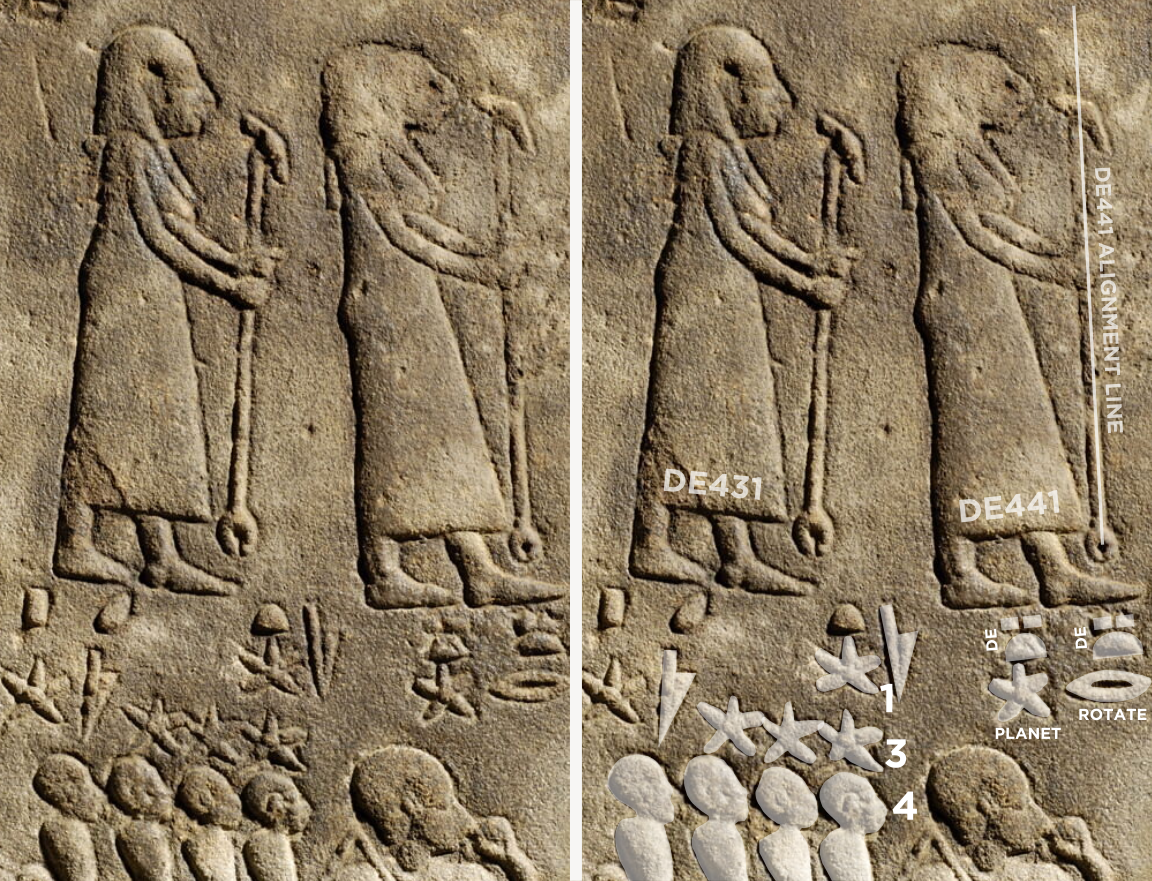
Illustration 6 - The secondary Moon alignment characters
The God on the left is annotated with the number 431 by using the 4 heads of the small characters at the bottom, the row of 3 stars and the single star. The two arrow like symbols specifically mark the the sections of the hieroglyphs that are relevant and separate out these characters from the 3:2 resonance stars that were seen on the Pluto page. The character on the right is walking ahead of the character on the left and is annotated by the hieroglyphs "rotate planet" with two small groups of hieroglyphs which have a semi circle with two small blocks, which looks very similar to stylised Roman lettering 'DE'. If the God walking behind is DE431 then the God on the right, which is the ancient Egyptian cat God 'Bastet' or the ancient Greek God 'Artemis', must be DE441. The staff that Bastet/Artemis is carrying has been labelled as the 'DE441 alignment line' which is used in the next section of this work.
If it is not clear from these carvings that it is the DE441 ephemeris data that is being corrected within the Dendera Zodiac's planet carvings, then this fact is repeated in more detail in the circle-like carving that is highlighted on the Decan ring on the main illustration. The following photograph shows a close up of that circle-like carving, and is shown with no rotations applied to any of the stonework. The main 'circular' element is aligned so that the heads of the upper row of characters within it are in a horizontal line. If you click the image, the image will change and the sequence of the explanation of the carving will appear. There are 4 images to look at and so you will need to click the image 4 times to view them
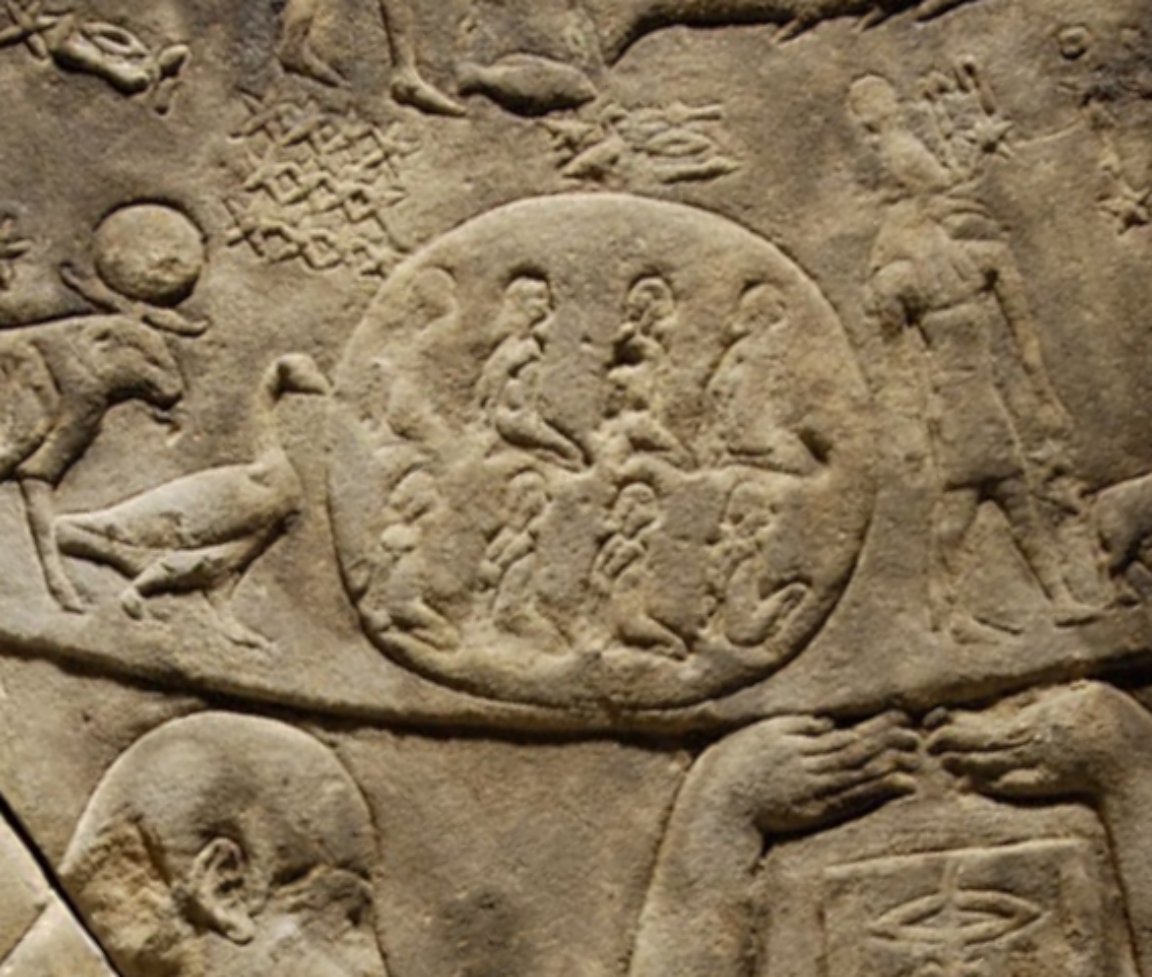
Illustration 7 - The Decan circle carving
The head of the northern standing Goddess is shown in the bottom of illustration 7, and part of the translation of the outer square frame hieroglyphs for this Goddess, which was shown on the index page of this website, is "my two arms are under the splendid place...as it is high upon my skull". Directly above the skull of the Goddess are the DE441 stars and the DE441 ephemeris is being directly referred to as the 'splendid place'.
The rotated NASA logo can now be placed onto the main illustration and the rest of the Decan symbols highlighted, ready for the final section of this work where the Julian Day number of the geometric winter solstice in 2729 BCE is extracted from the sculpture.
An ephemeris is not just a collection of numerical data, it has a set of starting parameters that specify which fundamental physics quantities have been used in its creation, such as lunar core-mantle damping calculations, and so it is essential to know what the underlying physics framework of the ephemeris data is.
NASA have produced a series of databases dating back to 'DE102' which was published in 1981 and continuing to the present day 'DE441' published in 2020 which replaced the previous ephemeris table 'DE431' which was published in 2013. There are fundamental differences between the DE441 and DE431 ephemerides and so the extracted data cannot just be slotted arbitrarily into whichever ephemeris one cares to choose.
To resolve this problem using the Dendera Zodiac's carving, the illustration can be reset so that all of the stones are in their natural position without any rotations applied and the Gods that are known to represent Neptune and Pluto on the inner night sky circle can be highlighted along with the large circular carving on the Decan ring that contains a number of kneeling figures carved into the circle.
The large standing Gods and the falcon Gods that were solved in the earlier parts of the analysis of the sculpture are lit up on the illustration and show that the large standing God on the top left has yet to be used for any purpose.
Looking at the Neptune and Pluto God characters first, the following photograph shows them exactly as they are carved, with no rotations applied to any of the stonework. The illustration has two halves, the left side shows the pure image and the right side shows the same characters with a series of important carved components highlighted.
Illustration 6 - The secondary Moon alignment characters
The God on the left is annotated with the number 431 by using the 4 heads of the small characters at the bottom, the row of 3 stars and the single star. The two arrow like symbols specifically mark the the sections of the hieroglyphs that are relevant and separate out these characters from the 3:2 resonance stars that were seen on the Pluto page. The character on the right is walking ahead of the character on the left and is annotated by the hieroglyphs "rotate planet" with two small groups of hieroglyphs which have a semi circle with two small blocks, which looks very similar to stylised Roman lettering 'DE'. If the God walking behind is DE431 then the God on the right, which is the ancient Egyptian cat God 'Bastet' or the ancient Greek God 'Artemis', must be DE441. The staff that Bastet/Artemis is carrying has been labelled as the 'DE441 alignment line' which is used in the next section of this work.
If it is not clear from these carvings that it is the DE441 ephemeris data that is being corrected within the Dendera Zodiac's planet carvings, then this fact is repeated in more detail in the circle-like carving that is highlighted on the Decan ring on the main illustration. The following photograph shows a close up of that circle-like carving, and is shown with no rotations applied to any of the stonework. The main 'circular' element is aligned so that the heads of the upper row of characters within it are in a horizontal line. If you click the image, the image will change and the sequence of the explanation of the carving will appear. There are 4 images to look at and so you will need to click the image 4 times to view them
Click this image for an explanation
Illustration 7 - The Decan circle carving
The head of the northern standing Goddess is shown in the bottom of illustration 7, and part of the translation of the outer square frame hieroglyphs for this Goddess, which was shown on the index page of this website, is "my two arms are under the splendid place...as it is high upon my skull". Directly above the skull of the Goddess are the DE441 stars and the DE441 ephemeris is being directly referred to as the 'splendid place'.
The rotated NASA logo can now be placed onto the main illustration and the rest of the Decan symbols highlighted, ready for the final section of this work where the Julian Day number of the geometric winter solstice in 2729 BCE is extracted from the sculpture.
EXTRACTING THE JULIAN DATE
It is possible to align a series of final stone rotations with the unused large standing God in the top left of the sculpture by extracting the corrected Julian Day value
of the geometric winter solstice, the event date, in the year 2729 BCE from the Dendera Zodiac.
The first step in extracting this date is to reset everything to its natural state with no stone rotations applied and highlight the Decan and Zodiac symbols noting that on the Decan ring the carving that is coloured in yellow is incomplete and therefore significant. The all important Moon line can then be drawn as a tangent to The Moon carving, the angle of this line being known from the geometry calculations on the Moon pages and is the projected longitude of the ascending node of the Moon rotated back into its absolute start position by applying a 33+1/3 anticlockwise rotation to it.
There is a small white circle at the end of the yellow Moon tangent line which represents The Moon and which is positioned exactly in the middle of the outer hieroglyph ring, the length of the line therefore being representative of the periapsis of The Moon in its orbit, because the width of the hieroglyph ring was defined as being equal to twice the focal length of The Moon's orbit. The exact value of The Moon line's angle from the computations is 331.0344248973241° clockwise from North and the length of the line is 112.62719526817828 cm.
The way that the Julian Day number is encoded into the sculpture is by way of angular rotations of the stone rings and circles in the same manner as was used to extract the numerical data throughout the previous sections of this work. The integer portion of the Julian Day number of the geometric winter solstice in 2729 BCE is known with certainty as being 724669 with only the decimal portion of the Day number, which gives the time of day, being in question.
Starting with the integer Julian Day number, the six digits of which it is comprised need to be applied to the Decan ring as clockwise rotations. Each of the Julian Day digits is multiplied by a factor of 10 and the result is then used as a degree value of rotation to be applied to the stone ring. Click the buttons bellow to apply the 70°, 20°, 40°, 60°, 60° and 90° rotations sequentially to the Decan stone ring.
The incompletely carved Decan character, the damaged part of which is is shaded in yellow, now needs to be aligned with the Moon line by applying the all important decimal portion of the Julian Day number of the geometric winter solstice event using the same system of multiplying the decimal value by 10 and then applying it as a clockwise angular rotation. This can be done by clicking the next button, with the explanation of how the number is calculated following on afterwards.
To get the decimal portion of the date to the precision shown on the last button there are three steps involved, all which can only be understood if the previous sections of the Dendera Zodiac puzzle have been solved. As the puzzle solver, you need to demonstrate that you understand the format that has been used when applying rotations to the sculpture in the planet pages. There are three types of rotations that are used; pure integer angular rotation; angular rotations that are projected onto the Moon's orbit plane; and angular rotation with decimal portions that are used at the end of sequences.
The very first angle rotation that was applied when extracting the numerical data from the carving on the Moon page was the application of a 376° angle which took the alignment line from being a tangent to the left side of the Moon carving to being a tangent to the right side. Implicit in this rotation was that the angular width of the Moon carving's circle is 16° and that when projected onto the plane of the Moon's orbit the angle is 15.151983621423396°, giving half of the Moon's width as being 7.575991810711698°. This is the detail that is now used for the final three rotations of the stonework.
Note that in the damaged section of the sculpture at the very top, the hieroglyph phrase 'northern sky' has appeared. This grouping of hieroglyphs is from the second mention of the phrase and is positioned in exactly the same location as the first mention was after the initial rotations. Also note that on the intermediate stone ring all 4 of the objects are now hidden behind the God carvings and the intermediate ring is now completely clear. This is because the intermediate ring represents space outside the solar system and is showing that when the ephemeris data is correct and the date is known, all of the unknown objects in space that have orbits outside the solar system, the comets and asteroids, can be accurately calculated.
Because the Julian Day number is a critical piece of information there are two sophisticated checking mechanisms to ensure that you have correctly decoded the data in the Dendera Zodiac.
The first of the cross checking mechanisms is very pleasing to the eye and uses Neptune's trident in the carvings of the Pisces area of the inner night sky circle and is best appreciated by zooming in on that section of the sculpture.
The two lines that come from the fish in Pisces are two of the prongs of the trident of the Neptune God, the third prong being the staff line itself. These three lines, along with the moon orbit ellipse, with the Moon's axes marked off in line with the arm of the God that is sitting inside the Moon ellipse, can be drawn on these carved features by clicking the next button.
All three lines and the Moon carving now need to be rotated clockwise by 57.5991810711698°, that value being derived directly from the decimal portion of half of the Moon carving's angular width projected onto the orbit plane that was used above to determine the decimal portion of the Julian Day.
If you want to run the animation again, click on the 'Moon components' button to reset the graphics.
The alignment of the lines is exquisite. The lower line runs straight through the two lines of the 'A' letters in the NASA logo, the middle line aligns perfectly with the axis of the rotated Moon carving and the upper line aligns with the model of The Moon that was positioned at its perigee distance from the carving center. The lengths of the lines are not arbitrary. The lower line, which terminates on the Decan ring's outer circumference is 92 cm long and the upper line is 74 cm long. The NASA logo that is displayed on the illustration was designed and used by NASA up to and including 1974, when it was replaced by another logo. However, the original logo was then reinstated in 1992. The two logo dates of '74 and '92 are how the line lengths were created. The central line which touches the Moon ellipse carving is 20.00 cm long and is another date reference to the year 2000 epoch (J2000) which is the fundamental reference point for the DE441 ephemeris coordinate system and time scale.
The second cross check of the Julian Day number involves understanding that the Dendera Zodiac can only be solved using the 'key' object that was recovered from the Great Pyramid of Giza's lower northern shaft. The Great Pyramid is a longitude marker for the geometric winter solstice in the year 2729 BCE and it has previously been established in an earlier work, "The world survey grid, baseline Giza" - page 26, diagram L30, that the north west corner of that building marks the longitude of the prime meridian of the mean 365.25 day length year, or 'Giza Mean Time'. The longitude of this line cannot simply be measured using GPS equipment because the phenomenon of tectonic plate movement, which has caused the African plate to drift north eastwards over time, needs to be taken into account. A diligent calculation of the original 2729 BCE longitude of the NW corner point of the Great Pyramid gave a GPS value of 31.132256°. This longitude is equivalent to 2 hours 4 minutes and 31.7416 seconds of time east of GPS zero and therefore a Julian Day decimal value of 0.913521508938099.
It is therefore possible to calculate the time difference between the Julian Day just given in the Dendera Zodiac for the 2729 BCE geometric winter solstice and the Julian Day of the Great Pyramid marker point, that difference being 0.254236090061901 JD. Expressed as a time difference it is 6 hours 6 minutes and 6 seconds, accurate to 1/500th second. This highly significant and rational value is a time difference between two meridian lines on Earth, but its value is not quite what the architects of the Dendera Zodiac and Great Pyramid have used in their astronomy data.
The time difference of 6hr 6min and 6sec is expressed in 12 hour clock format, and the actual value used in the astronomy calculations is 12 hours more than this, so 18hr 6mins 6 secs or a total of 65166 seconds. It is possible to derive this value as being the intended value because it is the value of a term in the DE441 ephemeris known as 'Delta T'. This value is the time difference between a clock ticking at uniform rate at the center of the solar system (UT TDB) and a clock ticking on Earth with Noon at the prime meridian being kept aligned to The Sun (UT), and is a measure of how the Earth's rotation slows down over time. The numerical value is given by NASA as being 65287.392991 seconds in the DE441 table at the moment of the geometric winter solstice in 2729 BCE. The standard deviation in this value is 1400 seconds in the year 2729 BCE, this error occurring because it is not possible to accurately model the rotation of the Earth over long time spans because we simply do not have the data to be able to do that.
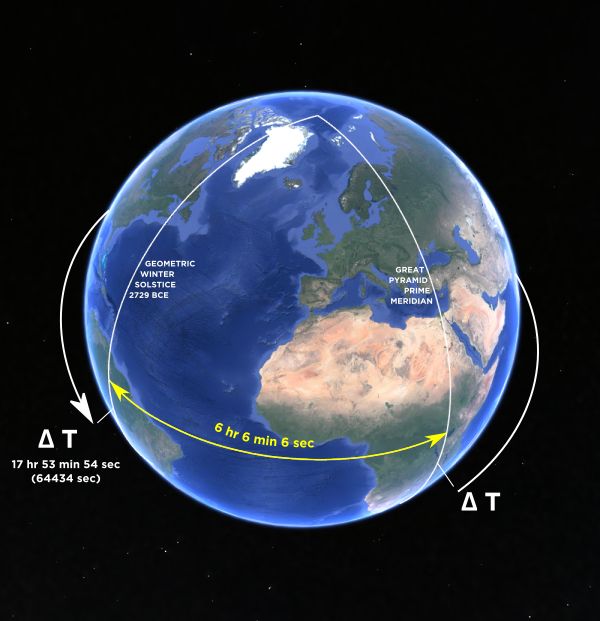
Illustration 5 - The value and orientation of Delta T in 2729 BCE
The correct value of Delta T on January 14th 2729 BCE at 16:01:34.2566 TDB is 65166.0 seconds.
The first step in extracting this date is to reset everything to its natural state with no stone rotations applied and highlight the Decan and Zodiac symbols noting that on the Decan ring the carving that is coloured in yellow is incomplete and therefore significant. The all important Moon line can then be drawn as a tangent to The Moon carving, the angle of this line being known from the geometry calculations on the Moon pages and is the projected longitude of the ascending node of the Moon rotated back into its absolute start position by applying a 33+1/3 anticlockwise rotation to it.
There is a small white circle at the end of the yellow Moon tangent line which represents The Moon and which is positioned exactly in the middle of the outer hieroglyph ring, the length of the line therefore being representative of the periapsis of The Moon in its orbit, because the width of the hieroglyph ring was defined as being equal to twice the focal length of The Moon's orbit. The exact value of The Moon line's angle from the computations is 331.0344248973241° clockwise from North and the length of the line is 112.62719526817828 cm.
The way that the Julian Day number is encoded into the sculpture is by way of angular rotations of the stone rings and circles in the same manner as was used to extract the numerical data throughout the previous sections of this work. The integer portion of the Julian Day number of the geometric winter solstice in 2729 BCE is known with certainty as being 724669 with only the decimal portion of the Day number, which gives the time of day, being in question.
Starting with the integer Julian Day number, the six digits of which it is comprised need to be applied to the Decan ring as clockwise rotations. Each of the Julian Day digits is multiplied by a factor of 10 and the result is then used as a degree value of rotation to be applied to the stone ring. Click the buttons bellow to apply the 70°, 20°, 40°, 60°, 60° and 90° rotations sequentially to the Decan stone ring.
The incompletely carved Decan character, the damaged part of which is is shaded in yellow, now needs to be aligned with the Moon line by applying the all important decimal portion of the Julian Day number of the geometric winter solstice event using the same system of multiplying the decimal value by 10 and then applying it as a clockwise angular rotation. This can be done by clicking the next button, with the explanation of how the number is calculated following on afterwards.
To get the decimal portion of the date to the precision shown on the last button there are three steps involved, all which can only be understood if the previous sections of the Dendera Zodiac puzzle have been solved. As the puzzle solver, you need to demonstrate that you understand the format that has been used when applying rotations to the sculpture in the planet pages. There are three types of rotations that are used; pure integer angular rotation; angular rotations that are projected onto the Moon's orbit plane; and angular rotation with decimal portions that are used at the end of sequences.
The very first angle rotation that was applied when extracting the numerical data from the carving on the Moon page was the application of a 376° angle which took the alignment line from being a tangent to the left side of the Moon carving to being a tangent to the right side. Implicit in this rotation was that the angular width of the Moon carving's circle is 16° and that when projected onto the plane of the Moon's orbit the angle is 15.151983621423396°, giving half of the Moon's width as being 7.575991810711698°. This is the detail that is now used for the final three rotations of the stonework.
- The night sky circle, Decan ring, intermediate ring, hieroglyph ring and Moon line need to be rotated anticlockwise by the angular width of The Moon carving
on the reference plane, 16 degrees, to get the first two digits of the decimal portion of the Julian Date.
- The Decan ring alone then needs to be rotated by 8°, half of the Moon carving's angular width on the reference plane, but the digit that is used in the
decimal portion of the Julian Day number is the integer portion of the projected angle, and therefore a 7.
- Finally, the night sky circle alone needs to be rotated by the value of half of the Moon carving's angular width projected onto the orbit plane, 7.575991810711698 degrees
with the decimal portion kept intact;
Note that in the damaged section of the sculpture at the very top, the hieroglyph phrase 'northern sky' has appeared. This grouping of hieroglyphs is from the second mention of the phrase and is positioned in exactly the same location as the first mention was after the initial rotations. Also note that on the intermediate stone ring all 4 of the objects are now hidden behind the God carvings and the intermediate ring is now completely clear. This is because the intermediate ring represents space outside the solar system and is showing that when the ephemeris data is correct and the date is known, all of the unknown objects in space that have orbits outside the solar system, the comets and asteroids, can be accurately calculated.
Because the Julian Day number is a critical piece of information there are two sophisticated checking mechanisms to ensure that you have correctly decoded the data in the Dendera Zodiac.
The first cross check
The first of the cross checking mechanisms is very pleasing to the eye and uses Neptune's trident in the carvings of the Pisces area of the inner night sky circle and is best appreciated by zooming in on that section of the sculpture.
The two lines that come from the fish in Pisces are two of the prongs of the trident of the Neptune God, the third prong being the staff line itself. These three lines, along with the moon orbit ellipse, with the Moon's axes marked off in line with the arm of the God that is sitting inside the Moon ellipse, can be drawn on these carved features by clicking the next button.
All three lines and the Moon carving now need to be rotated clockwise by 57.5991810711698°, that value being derived directly from the decimal portion of half of the Moon carving's angular width projected onto the orbit plane that was used above to determine the decimal portion of the Julian Day.
If you want to run the animation again, click on the 'Moon components' button to reset the graphics.
The alignment of the lines is exquisite. The lower line runs straight through the two lines of the 'A' letters in the NASA logo, the middle line aligns perfectly with the axis of the rotated Moon carving and the upper line aligns with the model of The Moon that was positioned at its perigee distance from the carving center. The lengths of the lines are not arbitrary. The lower line, which terminates on the Decan ring's outer circumference is 92 cm long and the upper line is 74 cm long. The NASA logo that is displayed on the illustration was designed and used by NASA up to and including 1974, when it was replaced by another logo. However, the original logo was then reinstated in 1992. The two logo dates of '74 and '92 are how the line lengths were created. The central line which touches the Moon ellipse carving is 20.00 cm long and is another date reference to the year 2000 epoch (J2000) which is the fundamental reference point for the DE441 ephemeris coordinate system and time scale.
The second cross check
The second cross check of the Julian Day number involves understanding that the Dendera Zodiac can only be solved using the 'key' object that was recovered from the Great Pyramid of Giza's lower northern shaft. The Great Pyramid is a longitude marker for the geometric winter solstice in the year 2729 BCE and it has previously been established in an earlier work, "The world survey grid, baseline Giza" - page 26, diagram L30, that the north west corner of that building marks the longitude of the prime meridian of the mean 365.25 day length year, or 'Giza Mean Time'. The longitude of this line cannot simply be measured using GPS equipment because the phenomenon of tectonic plate movement, which has caused the African plate to drift north eastwards over time, needs to be taken into account. A diligent calculation of the original 2729 BCE longitude of the NW corner point of the Great Pyramid gave a GPS value of 31.132256°. This longitude is equivalent to 2 hours 4 minutes and 31.7416 seconds of time east of GPS zero and therefore a Julian Day decimal value of 0.913521508938099.
It is therefore possible to calculate the time difference between the Julian Day just given in the Dendera Zodiac for the 2729 BCE geometric winter solstice and the Julian Day of the Great Pyramid marker point, that difference being 0.254236090061901 JD. Expressed as a time difference it is 6 hours 6 minutes and 6 seconds, accurate to 1/500th second. This highly significant and rational value is a time difference between two meridian lines on Earth, but its value is not quite what the architects of the Dendera Zodiac and Great Pyramid have used in their astronomy data.
The time difference of 6hr 6min and 6sec is expressed in 12 hour clock format, and the actual value used in the astronomy calculations is 12 hours more than this, so 18hr 6mins 6 secs or a total of 65166 seconds. It is possible to derive this value as being the intended value because it is the value of a term in the DE441 ephemeris known as 'Delta T'. This value is the time difference between a clock ticking at uniform rate at the center of the solar system (UT TDB) and a clock ticking on Earth with Noon at the prime meridian being kept aligned to The Sun (UT), and is a measure of how the Earth's rotation slows down over time. The numerical value is given by NASA as being 65287.392991 seconds in the DE441 table at the moment of the geometric winter solstice in 2729 BCE. The standard deviation in this value is 1400 seconds in the year 2729 BCE, this error occurring because it is not possible to accurately model the rotation of the Earth over long time spans because we simply do not have the data to be able to do that.
Illustration 5 - The value and orientation of Delta T in 2729 BCE
The correct value of Delta T on January 14th 2729 BCE at 16:01:34.2566 TDB is 65166.0 seconds.