The Moon data
The analysis of the Moon on the earlier page was carried out using the NASA DE441 ephemeris data for The Moon at the time of the geometric winter solstice in the year 2729 BCE.
If the Dendera Zodiac is to be of any use then it must contain its own numerical ephemeris data encoded into the sculpture's design. The inclination of the Moon's orbit has just
been extracted from the sculpture on the previous 'dimensions' page to a very high level of precision and the rest of the ephemeris data for the Moon can also be extracted
from the Dendera Zodiac to a level of accuracy which allows corrections to be made to the DE441 data. To accomplish this task, the data from the DE441 ephemeris is required at the moment of the geometric winter solstice in 2729 BCE and is shown in the tables below.

The Moon
Standard Gravitational Parameter (GM):
Ephemeris:
System center:
Reference frame:
Reference plane:
Event:
Date:
Standard Gravitational Parameter (GM):
Ephemeris:
System center:
Reference frame:
Reference plane:
Event:
Date:
OSCULATING ELEMENTS
e
Orbit eccentricity
QR
Periapsis distance (AU)
IN
Orbit Inclination (deg)
OM
Longitude of ascending node (deg)
W
Argument of periapsis (deg)
TP
Time of periapsis (JD)
N
Mean motion (deg/day)
MA
Mean anomaly (deg)
TA
True anomaly (deg)
a
Semi major axis (AU)
b
Semi minor axis (AU)
AD
Apoapsis distance (AU)
PR
Orbit period (day)
The Sun
Ephemeris:
System center:
Reference frame:
Reference plane:
Event:
Date:
Ephemeris:
DE441
System center:
Earth body center
Reference frame:
ICRF
Reference plane:
XY axis of ICRF
Event:
Geometric winter solstice
Date:
JD 724669.228769627 January 14th 2729 17:29:25.6958 BCE
Observer table
RA
Right ascension
18hr 14' 22.45" (273.5935416°)
EXTRACTING THE DENDERA ZODIAC'S EPHEMERIS DATA
To extract this numerical data from the sculpture the illustration of the Dendera Zodiac needs to be reset so that the stone rings are in their decrypted position and the principal elements
highlighted in white. In addition to the previous illustrations, the large circular carving on the Decan ring is highlighted on the image and the apsis line of the Moon,
which serves as the Dendera Zodiac's principal axis, is also drawn.
The way in which ephemeris values are encoded into the sculpture is by way of angular rotations of the Moon's apsis line, using either the section from the sculpture's geometric origin to the perigee point on the line (north) or by using the southern part that aligns with the apogee point.
To give an example of how this line is rotated in the Dendera Zodiac's numerical encryption system, take a random piece of numerical data from the NASA ephemeris such as 19.200778933263 degrees. This value needs to be split into discreet rotation values by separating it into its component parts of 192°, 0077°, 89°, 332° and 263° where each of the component parts is defined as having a value of 360 or less. The apsis line is then rotated by each of these values in turn and after each rotation the line will align with a carved feature on the sculpture.
There is also a highly sophisticated error checking mechanism built in to the Dendera Zodiac later on in its design. When the outer solar system planets are solved, a primary alignment feature of the solution is positioned on the Y axis of the sculpture which allows the Moon data that is extracted on this page to be calibrated. The full calibration system is explained in detail on the later outer solar system planet page when it is encountered. Any rotation values on this Moon data page that appear unrealistic, such as the alignment to the carvings of the Moon given in degrees to 3 decimal places, are a result of the error checking and subsequent calibration.
The longitude of the ascending node is the first of the values that can be decoded from the sculpture. To start with, a yellow line can be drawn onto the illustration which is positioned on the apsis line and angled in the direction of the perigee of The Moon. This line simply shows a geometric angle and is not showing the position of any particular celestial body so it is drawn with infinite length and has no circle at the end it.
The encrypted angle uses the two carvings of The Moon and its orbit that are highlighted in white in the central night sky circle on the illustration and the highlighted plinth of the intermediate stone ring, in the top right of the illustration. Because any error in the DE441 data will only be small, the integer portion of the angle's value given in table 2 can be guaranteed to be correct and it is only the decimal portion of the longitude of the ascending node that is encoded in the Dendera Zodiac. The value of the longitude of the ascending node from the NASA data in table two can be split into discreet values of 376°, 044°, 41° and 59° and then the rotations animated onto the illustration. The first of these values is 376° and deliberately breaks the 'less than 360' rule in order to confuse and obfuscate. It is the only angular rotation value in the whole of the Dendera Zodiacs system for all of the planets that breaks the 360 degree rule.
The corrected value for the longitude of the ascending node is shown on the buttons below, which can be clicked in sequential order to apply the clockwise angular rotation to the yellow line which, at every step, aligns with distinct carved features on the sculpture.
The same system is used to extract the argument of periapsis value but this time everything is done in the opposite manner with the starting position of the angle line pointing to the other end of the Moon's orbit apsis line at the apogee, and the rotations are performed in an anticlockwise manner. The reason for doing this is not arbitrary but is explained in the hieroglyphs in the plinth that is located in the top right of the intermediate stone ring, which is used in this set of rotations.
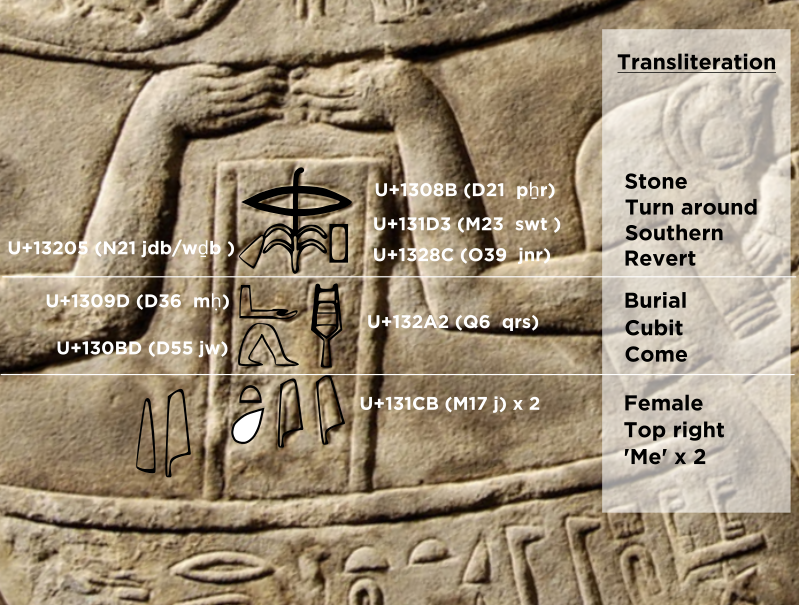
Illustration 2 - The plinth on the intermediate stone ring
The first phrase tells you the instructions of how to perform the rotation, in reverse. The second phrase tells you to 'walk by a cubit to the burial', or rotate by one cubit to the final point and the third phrase is the hieroglyphs for 'female me', the 'me' word being repeated two times, along with a tear drop pointer, which is filled in white on the image. This third phrase tells you to align the final rotation to the eastern standing Goddess located at the top right of the carving.
To carry out the second instruction it is necessary to know that the division circle between the night sky and the Decans has a circumference of 360 cm, as was explained on the previous page, so that one degree of rotation on this circle is also one cm on that circle's circumference. Because the Ancient Egyptian cubit is known to be 52.33 cm and all rotations are in integer values, the final part of the rotation system must be 52°. To carry out these instructions, the start position of the line can be set to the apogee position on the illustration by clicking the next button.
The value of the argument of periapsis from table 2 can be broken down into its angular rotation discreet values, 332°, 153°, 258°, 80°, 119° and 3° and then these values can be used to investigate the sculpture whereupon the corrected value of the argument of periapsis can be determined from the logic which appears during the rotations. Click the following buttons in sequential order to apply the anticlockwise rotations to the geometry line.
Because the two rotation angles just determined are those required to solve the position of the rotated stone split line as explained when calculating the Dendera Zodiac's dimensions on the previous page, the precise orbital tilt value can now be determined by running the iterative mathematics function to completion, giving a value for The Moon's orbit tilt at the moment of the 2729 BCE geometric winter solstice as being 19.200778617978486°, with all of the digits being significant.
Remembering that the goal at this point is to acquire the numerical data necessary to solve equation 1 at the bottom of the Moon page, the next value to be investigated is the geocentric right ascension of The Sun at the moment of the geometric winter solstice. Because this quantity is a relative measurement and specifies how long after the winter solstice the geometric winter solstice occurred, the value given in the DE441 ephemeris would be expected to be very accurate indeed. The value given by NASA in table 3 can be separated into its discreet rotation values as 273°, 59°, 354° and 16° and these values can be animated onto the illustration by first drawing on the Earth's celestial axes that were determined on the Moon page and then placing the yellow angle line into its start position in line with the celestial north axis.
The discreet rotations for the right ascension value can now be applied by clicking the following buttons in sequence.
With all but one of the values for equation 1 now known, the equation can be rearranged to give the value of the true anomaly of The Moon.
The eccentricity of the Moon's orbit can be extracted by first setting the geometry rotation line into its position aligned with the apogee on the apsis line by clicking on the following button.
To determine the orbit eccentricity of The Moon's orbit given in the Dendera Zodiac the value from the DE441 ephemeris in table 2 can be split into its discreet rotation values of 061°, 073°, 90°, 30° and 78° and then these angular rotations applied until the correction to the last of the digits can be determined.
The corrected numerical value of the eccentricity is shown on the buttons below which can be clicked in sequence to rotate the apogee line around the Dendera Zodiac in an anticlockwise direction.
This gives the eccentricity of The Moon's orbit at the moment of the geometric winter solstice in 2729 BCE as 0.0610739062441
The sidereal orbit period, measured in days, can be extracted from the sculpture by first placing a geometry line onto the illustration aligned with the apogee direction on the apsis line.
Using the same methods already used of looking up the orbit period's value on the DE441 ephemeris and splitting into its discreet values of 268°, 80°, 104°, 356°, 71° and 6° and then searching for the angles within the sculpture and refining the least significant digits, the sidereal orbit period's numerical value can be determined and is shown by clicking the following sequence of buttons in order.
The semi minor axis is given in the DE441 data in table two and can be split down into its discreet rotation angles of 253°, 93°, 46°, 70° and 20° and then these values applied as anticlockwise rotations in the same manner as the previously. The geometry line can be repositioned to the apogee direction by clicking the following button.
Each of the angles can then be applied as a rotation by clicking the following buttons in sequence. 0.00253934650 132
Click the following button to reset the animation and place a line onto the illustration aligned to the top of the illustration on the sculpture's Y axis.
Before extracting the final value from the stonework there are two additional carvings that need to be highlighted on the Dendera Zodiac. The first is a carving on the outer frame that looks like accidental damage but clearly isn't, and the second is a major carving of Horus located on the inner night sky ring that has already been used as an alignment carving in the orbit eccentricity section above.
The carving that looks like damage on the outer frame in the lower left is a stylised carving of an irregularly shaped solar system body, with its atmosphere, and with two moons in orbit around it. The moons are small carved circles in the stonework and the one above the planet is directly in line with the center of the planet carving's straight edge on the outer bounding box of the Dendera Zodiac. This straight edge center point is the alignment marker at the center of this mini planet system that is used to extract the Standard Gravitational Parameter (GM) value.
The carving of Horus on the inner night sky ring on the right side is a carving of the God standing on top of what scholars have termed as 'a sword' but clearly isn't. Below the 'sword' object are two stars which represent The Moon and The Earth, which are on the Decan ring, showing that this alignment carving is used for both the planet and its moon when extracting the numerical data from the system. This carving is necessary so that the required precision in the GM value can be specified in the sculpture.
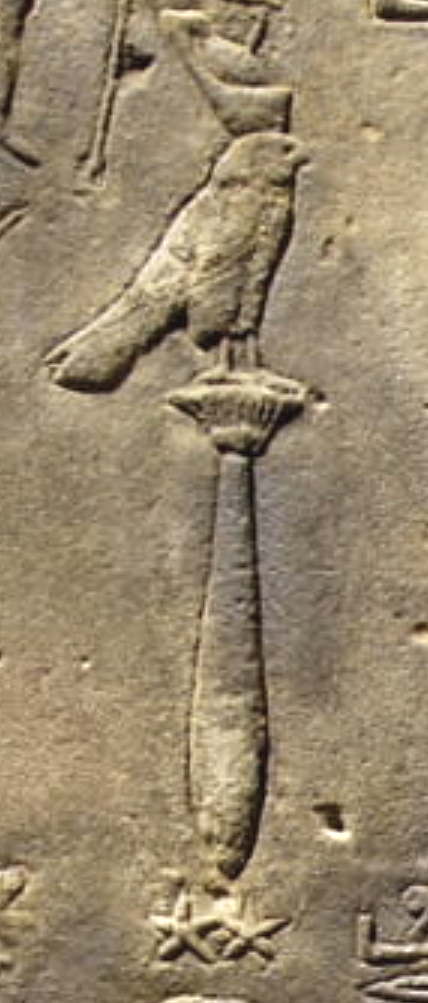
Illustration 3 - The Horus God carving
The value of GM for The Moon given in the DE441 ephemeris is 4902.800118 which splits into 49°, 280° and 118° and the corresponding rotations, with the final digits corrected, can be animated onto the illustration by clicking the following buttons in sequence.
The way in which ephemeris values are encoded into the sculpture is by way of angular rotations of the Moon's apsis line, using either the section from the sculpture's geometric origin to the perigee point on the line (north) or by using the southern part that aligns with the apogee point.
To give an example of how this line is rotated in the Dendera Zodiac's numerical encryption system, take a random piece of numerical data from the NASA ephemeris such as 19.200778933263 degrees. This value needs to be split into discreet rotation values by separating it into its component parts of 192°, 0077°, 89°, 332° and 263° where each of the component parts is defined as having a value of 360 or less. The apsis line is then rotated by each of these values in turn and after each rotation the line will align with a carved feature on the sculpture.
There is also a highly sophisticated error checking mechanism built in to the Dendera Zodiac later on in its design. When the outer solar system planets are solved, a primary alignment feature of the solution is positioned on the Y axis of the sculpture which allows the Moon data that is extracted on this page to be calibrated. The full calibration system is explained in detail on the later outer solar system planet page when it is encountered. Any rotation values on this Moon data page that appear unrealistic, such as the alignment to the carvings of the Moon given in degrees to 3 decimal places, are a result of the error checking and subsequent calibration.
The longitude of the ascending node is the first of the values that can be decoded from the sculpture. To start with, a yellow line can be drawn onto the illustration which is positioned on the apsis line and angled in the direction of the perigee of The Moon. This line simply shows a geometric angle and is not showing the position of any particular celestial body so it is drawn with infinite length and has no circle at the end it.
The encrypted angle uses the two carvings of The Moon and its orbit that are highlighted in white in the central night sky circle on the illustration and the highlighted plinth of the intermediate stone ring, in the top right of the illustration. Because any error in the DE441 data will only be small, the integer portion of the angle's value given in table 2 can be guaranteed to be correct and it is only the decimal portion of the longitude of the ascending node that is encoded in the Dendera Zodiac. The value of the longitude of the ascending node from the NASA data in table two can be split into discreet values of 376°, 044°, 41° and 59° and then the rotations animated onto the illustration. The first of these values is 376° and deliberately breaks the 'less than 360' rule in order to confuse and obfuscate. It is the only angular rotation value in the whole of the Dendera Zodiacs system for all of the planets that breaks the 360 degree rule.
The corrected value for the longitude of the ascending node is shown on the buttons below, which can be clicked in sequential order to apply the clockwise angular rotation to the yellow line which, at every step, aligns with distinct carved features on the sculpture.
Longitude of the ascending node (deg)
- The first rotation positions the line as a tangent to the other side of The Moon carving
- The second rotation positions the line along the right side of the plinth
- The third rotation positions the line as a tangent to the base of The Moon, aligned with the lion's tail and the legs of the western standing Goddess
The same system is used to extract the argument of periapsis value but this time everything is done in the opposite manner with the starting position of the angle line pointing to the other end of the Moon's orbit apsis line at the apogee, and the rotations are performed in an anticlockwise manner. The reason for doing this is not arbitrary but is explained in the hieroglyphs in the plinth that is located in the top right of the intermediate stone ring, which is used in this set of rotations.
Illustration 2 - The plinth on the intermediate stone ring
The first phrase tells you the instructions of how to perform the rotation, in reverse. The second phrase tells you to 'walk by a cubit to the burial', or rotate by one cubit to the final point and the third phrase is the hieroglyphs for 'female me', the 'me' word being repeated two times, along with a tear drop pointer, which is filled in white on the image. This third phrase tells you to align the final rotation to the eastern standing Goddess located at the top right of the carving.
To carry out the second instruction it is necessary to know that the division circle between the night sky and the Decans has a circumference of 360 cm, as was explained on the previous page, so that one degree of rotation on this circle is also one cm on that circle's circumference. Because the Ancient Egyptian cubit is known to be 52.33 cm and all rotations are in integer values, the final part of the rotation system must be 52°. To carry out these instructions, the start position of the line can be set to the apogee position on the illustration by clicking the next button.
The value of the argument of periapsis from table 2 can be broken down into its angular rotation discreet values, 332°, 153°, 258°, 80°, 119° and 3° and then these values can be used to investigate the sculpture whereupon the corrected value of the argument of periapsis can be determined from the logic which appears during the rotations. Click the following buttons in sequential order to apply the anticlockwise rotations to the geometry line.
Argument of periapsis (deg)
- The position of the line after the first rotation is not important, because the integer value must be 332°
- The second rotation positions the line exactly on the hieroglyph marker line in the middle of the plinth
- The third rotation positions the line so that the final rotation is exactly 52 °
- The final rotation places the line aligned with legs of the bull carving on the inner night sky and the headdress of the eastern standing Goddess
Orbit inclination (deg)
Because the two rotation angles just determined are those required to solve the position of the rotated stone split line as explained when calculating the Dendera Zodiac's dimensions on the previous page, the precise orbital tilt value can now be determined by running the iterative mathematics function to completion, giving a value for The Moon's orbit tilt at the moment of the 2729 BCE geometric winter solstice as being 19.200778617978486°, with all of the digits being significant.
Remembering that the goal at this point is to acquire the numerical data necessary to solve equation 1 at the bottom of the Moon page, the next value to be investigated is the geocentric right ascension of The Sun at the moment of the geometric winter solstice. Because this quantity is a relative measurement and specifies how long after the winter solstice the geometric winter solstice occurred, the value given in the DE441 ephemeris would be expected to be very accurate indeed. The value given by NASA in table 3 can be separated into its discreet rotation values as 273°, 59°, 354° and 16° and these values can be animated onto the illustration by first drawing on the Earth's celestial axes that were determined on the Moon page and then placing the yellow angle line into its start position in line with the celestial north axis.
The discreet rotations for the right ascension value can now be applied by clicking the following buttons in sequence.
Geocentric Sun right ascension (deg)
- Aligns with the body of the falcon God on the left side
- Does not align to any carved feature
- Does not align to any carved feature
- Aligns with the headdress of the southern standing Goddess
With all but one of the values for equation 1 now known, the equation can be rearranged to give the value of the true anomaly of The Moon.
3 x 360 (deg)
1080.0
- OM' (deg)
355.6322415753658
- W (deg)
332.15329052
- RA (deg)
273.59354165
= TA (deg)
118.62092625463418
True anomaly (deg)
This is the corrected value of the true anomaly of The Moon at the moment of the 2729 BCE geometric winter solstice and only uses data that has been extracted from the
Dendera Zodiac carving in its formation. The reason that it has been specified in an equation rather than by angular rotations is that it is substantially different from
the DE441 value and it would have been impossible to determine using the rotation method where the corrected and DE441 values need to be numerically similar.
The eccentricity of the Moon's orbit can be extracted by first setting the geometry rotation line into its position aligned with the apogee on the apsis line by clicking on the following button.
To determine the orbit eccentricity of The Moon's orbit given in the Dendera Zodiac the value from the DE441 ephemeris in table 2 can be split into its discreet rotation values of 061°, 073°, 90°, 30° and 78° and then these angular rotations applied until the correction to the last of the digits can be determined.
The corrected numerical value of the eccentricity is shown on the buttons below which can be clicked in sequence to rotate the apogee line around the Dendera Zodiac in an anticlockwise direction.
Orbit eccentricity
- The first rotation aligns with the carving of Horus perched ontop of a sword on the inner night sky section of the sculpture
- Does not align to any carved feature
- Aligns with the Moon carving in the hieroglyph ring
- The final alignment positions the geometry line as a tangent to the Moon orbit ellipse carving and inline with the western standing Goddess
This gives the eccentricity of The Moon's orbit at the moment of the geometric winter solstice in 2729 BCE as 0.0610739062441
The sidereal orbit period, measured in days, can be extracted from the sculpture by first placing a geometry line onto the illustration aligned with the apogee direction on the apsis line.
Using the same methods already used of looking up the orbit period's value on the DE441 ephemeris and splitting into its discreet values of 268°, 80°, 104°, 356°, 71° and 6° and then searching for the angles within the sculpture and refining the least significant digits, the sidereal orbit period's numerical value can be determined and is shown by clicking the following sequence of buttons in order.
Orbital period (days)
- Does not align to any carved feature
- Does not align to any carved feature
- Does not align to any carved feature
- Does not align to any carved feature
- The final rotation aligns with the tangent to the Moon carving
The semi minor axis is given in the DE441 data in table two and can be split down into its discreet rotation angles of 253°, 93°, 46°, 70° and 20° and then these values applied as anticlockwise rotations in the same manner as the previously. The geometry line can be repositioned to the apogee direction by clicking the following button.
Each of the angles can then be applied as a rotation by clicking the following buttons in sequence. 0.00253934650 132
Semi minor axis (AU)
- Does not align to any carved feature
- Does not align to any carved feature
- Does not align to any carved feature
- Does not align to any carved feature
- The final rotation aligns the geometry line as a tangent to the large circular carving in the Decan ring
Click the following button to reset the animation and place a line onto the illustration aligned to the top of the illustration on the sculpture's Y axis.
Before extracting the final value from the stonework there are two additional carvings that need to be highlighted on the Dendera Zodiac. The first is a carving on the outer frame that looks like accidental damage but clearly isn't, and the second is a major carving of Horus located on the inner night sky ring that has already been used as an alignment carving in the orbit eccentricity section above.
The carving that looks like damage on the outer frame in the lower left is a stylised carving of an irregularly shaped solar system body, with its atmosphere, and with two moons in orbit around it. The moons are small carved circles in the stonework and the one above the planet is directly in line with the center of the planet carving's straight edge on the outer bounding box of the Dendera Zodiac. This straight edge center point is the alignment marker at the center of this mini planet system that is used to extract the Standard Gravitational Parameter (GM) value.
The carving of Horus on the inner night sky ring on the right side is a carving of the God standing on top of what scholars have termed as 'a sword' but clearly isn't. Below the 'sword' object are two stars which represent The Moon and The Earth, which are on the Decan ring, showing that this alignment carving is used for both the planet and its moon when extracting the numerical data from the system. This carving is necessary so that the required precision in the GM value can be specified in the sculpture.
Illustration 3 - The Horus God carving
The value of GM for The Moon given in the DE441 ephemeris is 4902.800118 which splits into 49°, 280° and 118° and the corresponding rotations, with the final digits corrected, can be animated onto the illustration by clicking the following buttons in sequence.
GMearth (km3 s-2)
- Does not align to any carved feature
- Does not align to any carved feature
- Aligns with the Standard Gravity Parameter marker on the 'sword' of Horus
- Aligns with the Standard Gravity Parameter marker in the mini planet model
THE DENDERA ZODIAC EPHEMERIS DATA
The ephemeris data from the Dendera Zodiac for The Moon, which has the constraints of NASA's DE441 ephemeris, can now be displayed.

The Moon
Standard Gravitational Parameter (GM):
Ephemeris:
Event:
Date:
System center:
Reference frame:
Reference plane:
Delta T:
Standard Gravitational Parameter (GM):
Ephemeris:
(DE441 conditions)
Event:
Date:
System center:
Reference frame:
Reference plane:
Delta T:
64434.0 seconds
Osculating elements
e
Orbit eccentricity
QR
Periapsis distance (AU)
IN
Orbit Inclination (deg)
OM
Longitude of ascending node (deg)
W
Argument of periapsis (deg)
TP
Time of periapsis (JD)
N
Mean motion (deg/day)
MA
Mean anomaly (deg)
TA
True anomaly (deg)
a
Semi major axis (AU)
b
Semi minor axis (AU)
AD
Apoapsis distance (AU)
PR
Orbit period (day)
NEXT PAGE - MERCURY