Pluto
The main illustration currently shows the Dendera Zodiac in its natural state with no rotations applied to the stones and with the Pluto God highlighted in the night sky circle.
The decryption rotations need to be applied to the stone circles to be able to start to analyse the manner in which Pluto is encoded into the carving,
which can be performed by clicking the next button.
The orbits of the planets Neptune and Pluto are linked together in space by an orbital resonance where for every three orbits that Neptune completes, Pluto completes exactly two. This is why the two Gods representing these two planets are following each other closely as a pair of Gods on the Dendera Zodiac sculpture allowing Pluto to be identified. Illustration 5 shows the two planet Gods with the stars below the Pluto God showing the 3:2 resonance of the planet's orbit periods and the overall design of the carving being full of 3:2 ratios.
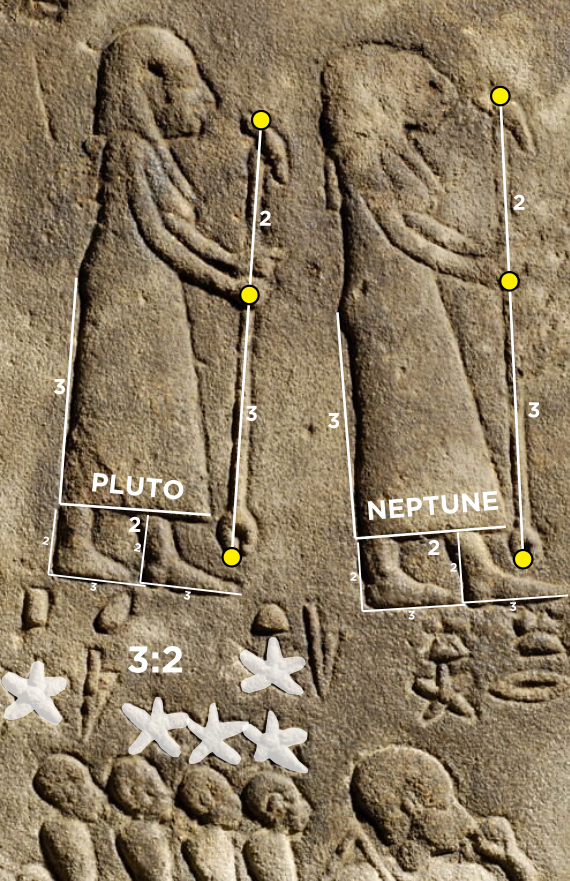
Illustration 5 - The Pluto and Neptune carvings
The starting lines and points for the formation geometry of Pluto can now be added to the illustration and are different from those used in previous planets. The celestial axes and the focal points from the planet Uranus are required, rather than those of the previous planet Neptune, and can be added to the illustration by clicking the next button.
The staff of the Pluto God is formed by first finding the staff line of Neptune, as was done on the previous page, and which can be shown by clicking the following button.
Once Neptune's staff line and the hand of the Neptune God has been found then this staff line and hand point can be rotated around the focal point of Uranus to form the staff line and point at the hand of the Pluto God. The rotation angle is taken directly from the ephemeris data, as always, and is the Y coordinate of the state vector of Pluto at the moment of the geometric winter solstice in the year 2729 BCE, 5.293002217862 AU, with the unit converted from AU to degrees. The staff line of Pluto and the Pluto hand of God can be added to the illustration by clicking the next button
With the staff line and points established the formation of the Pluto system's astronomy lines was investigated on a graphics programme so that the required orientation of the axes could be determined. The celestial axes can be rotated into position on the Pluto God by clicking the following button.
The orbits of the planets Neptune and Pluto are linked together in space by an orbital resonance where for every three orbits that Neptune completes, Pluto completes exactly two. This is why the two Gods representing these two planets are following each other closely as a pair of Gods on the Dendera Zodiac sculpture allowing Pluto to be identified. Illustration 5 shows the two planet Gods with the stars below the Pluto God showing the 3:2 resonance of the planet's orbit periods and the overall design of the carving being full of 3:2 ratios.
Illustration 5 - The Pluto and Neptune carvings
The starting lines and points for the formation geometry of Pluto can now be added to the illustration and are different from those used in previous planets. The celestial axes and the focal points from the planet Uranus are required, rather than those of the previous planet Neptune, and can be added to the illustration by clicking the next button.
1) RESOLVING THE FRAMEWORK OF PLUTO
The staff of the Pluto God is formed by first finding the staff line of Neptune, as was done on the previous page, and which can be shown by clicking the following button.
Once Neptune's staff line and the hand of the Neptune God has been found then this staff line and hand point can be rotated around the focal point of Uranus to form the staff line and point at the hand of the Pluto God. The rotation angle is taken directly from the ephemeris data, as always, and is the Y coordinate of the state vector of Pluto at the moment of the geometric winter solstice in the year 2729 BCE, 5.293002217862 AU, with the unit converted from AU to degrees. The staff line of Pluto and the Pluto hand of God can be added to the illustration by clicking the next button
With the staff line and points established the formation of the Pluto system's astronomy lines was investigated on a graphics programme so that the required orientation of the axes could be determined. The celestial axes can be rotated into position on the Pluto God by clicking the following button.
2) SOLVING PLUTO USING NASA DE441 DATA
The construction lines from the Uranus planet used in the formation geometry can be removed from the illustration by clicking the next button, leaving Pluto's celestial axes and the Pluto God on the illustration and also adding the GM Standard Gravitational Parameter carving to the bottom of the outer frame.
It is now possible to animate Pluto's three principal astronomy angles onto the illustration in the same manner as was done on all previous pages. In order to do this the NASA ephemeris data is required for the Pluto planet system, which includes Pluto and its moons rotating around a common barycenter, at the moment given in DE441 for the geometric winter solstice of 2729 BCE.

Pluto system Barycenter
Standard Gravitational Parameter (GM):
Ephemeris:
Event:
Date:
System center:
Reference frame:
Reference plane:
Standard Gravitational Parameter (GM):
Ephemeris:
Event:
Date:
System center:
Reference frame:
Reference plane:
Osculating elements
e
Orbit eccentricity
QR
Periapsis distance (AU)
IN
Orbit Inclination (deg)
OM
Longitude of ascending node (deg)
W
Argument of periapsis (deg)
TP
Time of periapsis (JD)
N
Mean motion (deg/day)
MA
Mean anomaly (deg)
TA
True anomaly (deg)
a
Semi major axis (AU)
b
Semi minor axis (AU)
AD
Apoapsis distance (AU)
PR
Orbit period (day)
State vectors
X
X (AU)
Y
Y (AU)
Z
Z (AU)
The first of the astronomy angles to be animated is the longitude of the ascending node angle of the Pluto planet system's orbit projected from the ICRF reference plane onto the plane of the orbit of The Moon, which is the plane of the Dendera Zodiac. This can be shown on the illustration by clicking the following button and the resulting red line aligns with the body of the large standing Goddess on the lower right of the sculpture.
The argument of periapsis is the next angle that can be plotted by clicking the following button.
The focal points of the orbit of the Neptune planet system can now be marked onto the green apsis line.
The final of the three principal astronomy angles is the true anomaly and this can be animated onto the illustration by clicking the next button.
The coloured arcs can be removed from the animation to leave just the celestial axes and the three principal astronomy angles of Pluto by clicking the next button.
The only way that geometric alignments can be checked is by making sure that the GM line for Pluto points to a distinctly carved principal feature of the Dendera Zodiac. This can be checked by taking the value of GM for Pluto from the raw NASA DE441 data in table 21, 975.5, splitting it into its component parts that will be used in the next section when the data is being extracted, 97° and 55°, adding these together to give 152 degrees. This angular value can be plotted onto the illustration as a line rotated clockwise around the celestial axes center point starting from the celestial north direction, and the resulting location of that line can be seen by clicking the following button.
The geometric system finishes with the movement of the astronomy lines and celestial axes that was seen on the previous pages which are moved to the western focal point of the planet system's orbit. The geometry lines are rotated by 90° anticlockwise during the translation of their center point onto the focal point and this can be animated onto the illustration using the next button.
The reason that the geometry for the planet Pluto can be worked out is because when the alignment of the system has been correctly performed the GM line for Pluto falls along a principal carved feature of the sculpture, and the geometry configuration currently on the illustration is the only one that provides such an alignment. The GM line alignment can be highlighted by clicking the following button.
3) EXTRACTING THE EPHEMERIS DATA FOR PLUTO
The astronomy lines are no longer required and, by clicking the next button, they can be removed from the illustration to leave just the celestial axes of Pluto centered on the western focal point and with the gravity carving showing at the base of the sculpture.
GMearth (km3 s-2)
Longitude of the ascending node (deg)
Argument of periapsis (deg)
Mean anomaly (deg)
Orbit eccentricity
Orbit inclination (deg)
Semi minor axis (AU)
Orbital period (days)
4) THE DENDERA EPHEMERIS DATA FOR PLUTO
The full ephemeris data for the Pluto planet system at the moment of the geometric winter solstice in 2729 BCE, taken entirely from the Dendera Zodiac, is shown below in table 22.
The values in the table that were not directly extracted from the stonework have been calculated from the extracted values using the software than runs this
website by applying standard celestial mechanics formulae.

Pluto system barycenter
Standard Gravitational Parameter (GM):
Ephemeris:
Event:
Date:
System center:
Reference frame:
Reference plane:
Standard Gravitational Parameter (GM):
Ephemeris:
(DE441 conditions)
Event:
Date:
System center:
Reference frame:
Reference plane:
Osculating elements
e
Orbit eccentricity
QR
Periapsis distance (AU)
IN
Orbit Inclination (deg)
OM
Longitude of ascending node (deg)
W
Argument of periapsis (deg)
TP
Time of periapsis (JD)
N
Mean motion (deg/day)
MA
Mean anomaly (deg)
TA
True anomaly (deg)
a
Semi major axis (AU)
b
Semi minor axis (AU)
AD
Apoapsis distance (AU)
PR
Orbit period (day)
State vectors
X
X (AU)
Y
Y (AU)
Z
Z (AU)